
Finding a place to live is the very first necessity when you move to Canada. Whether you are after an apartment, a condo, a basement unit, or a shared room, housing will be the single largest slice of your monthly budget.
Plenty of newcomers look at a $2,500 CAD monthly rental budget and assume it guarantees a premium lifestyle or it's an expensive fixed cost. Inside today's Ontario rental market, that assumption is a serious eye opener. Before you pack your bags, let's break down the hidden costs, the city-by-city price shifts, and the landlord expectations you need to prepare for.
This guide is written from lived experience. I have rented in North York, Brampton, and Guelph, so the numbers and warnings below come from the ground, not a brochure.
1. The Hidden Costs of Renting in Ontario (the “Second Rent”)
Many newcomers assume the advertised rent is the final number. It rarely is. In Ontario, renting an apartment usually comes with an unbundled list of “minor costs” that quickly stack into a major expense.
When you calculate your true cost of living in Ontario, factor in these extra monthly utilities and fees:
- Hydro (electricity): Often billed separately from your base rent.
- Gas and water: Depending on the building, heating and air conditioning may not be included.
- Wi-Fi and internet: Canada has some of the highest telecom costs in the world. Expect to pay $80 to $110 a month.
- Parking: If you lease a modern condo, parking is rarely free and can add $50 to $150 a month.
- Tenant insurance: The large majority of Ontario landlords require proof of tenant insurance before handing over the keys, usually $30 to $50 a month.
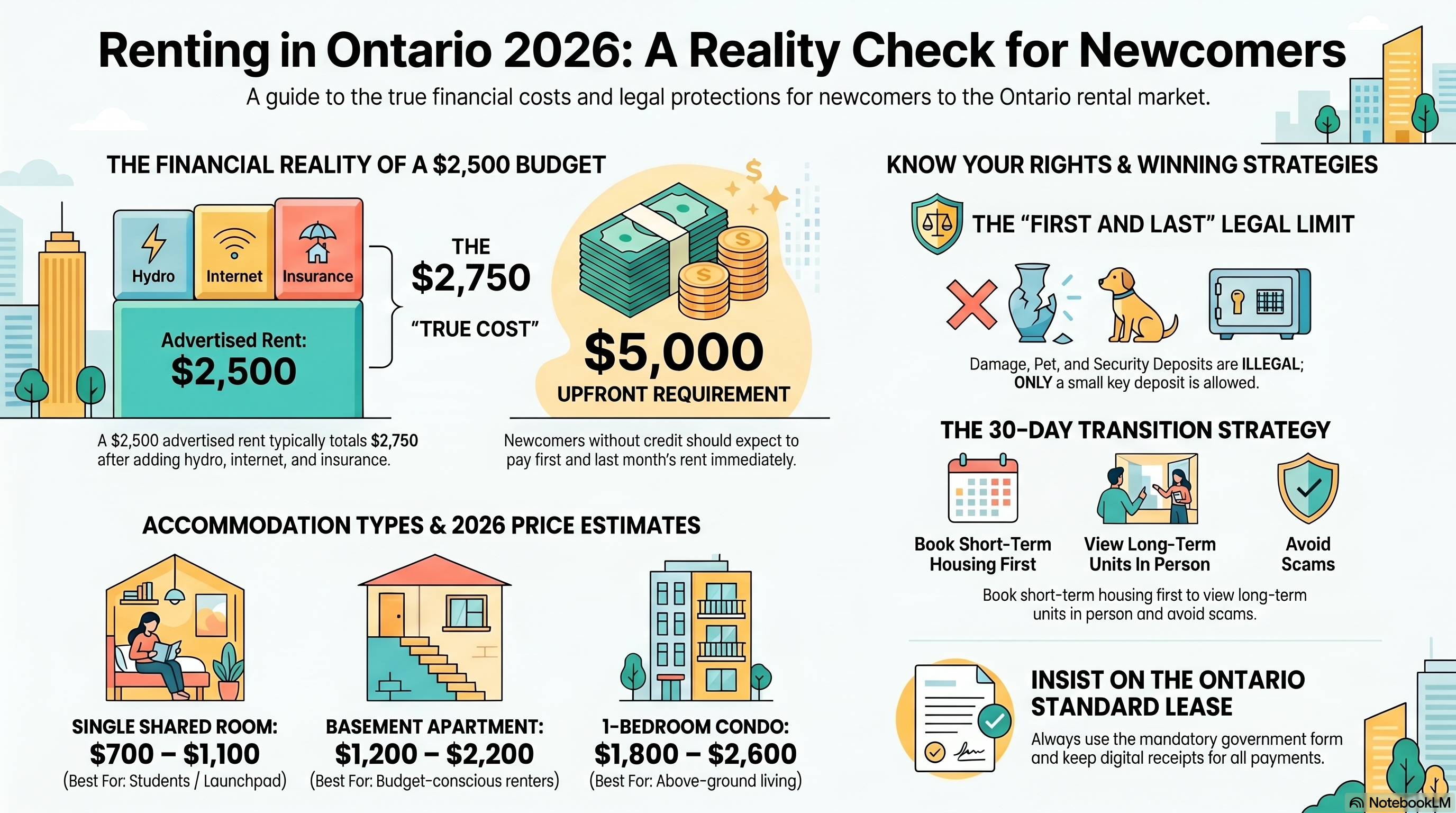
Add it all up and a $2,500 advertised apartment can easily cost $2,750 or more out of pocket every single month. Always confirm with the landlord exactly what is included in the lease before you sign.
2. Renting in Ontario With No Credit History: Screening and Deposits
Ontario's tenant laws strongly protect renters, landlords tend to be risk-averse. To secure a lease, the standard requests are:
- A background or employment check.
- A Canadian credit score check (Equifax or TransUnion).
- Your last three paystubs as proof of stable income.
The Newcomer Catch
If you just landed in Canada, you have no local credit score and no Canadian job history. Landlords will typically ask you to provide first and last month's rent together upfront.
Here is the part most newcomers do not know: in Ontario, first and last month's rent is the legal limit. Separate damage deposits, pet deposits, and security deposits are not allowed. The only extra a landlord can collect is a refundable key deposit capped at the actual replacement cost. If anyone asks for a “security deposit” on top of first and last, that is a red flag.
A few ways to win over a cautious landlord when you have no credit:
- Provide a bank letter or recent statements proving you can cover several months.
- Show a job offer letter if you have one lined up before you land. Many landlords treat it as nearly as good as a paystub.
- Line up a Canadian guarantor or co-signer with good credit if you can.
- Explain plainly that you are new and have not built Canadian credit yet. You are far from the first person in this position.
- Be polite to them while speaking.
3. How to Secure Housing Before You Even Land in Canada
This is where most newcomers get stuck. You are still in your home country, you have no Canadian credit history, and you need somewhere to sleep when your flight lands. Here is the realistic path.
Start With a Room, Not an Apartment
Trying to lock down a full apartment lease from outside Canada is very difficult, especially with corporate property managers who run strict automated credit checks. The smarter first move is to rent a room from a private landlord. Private landlords are far more flexible on screening, often skip the credit check entirely, and charge a smaller deposit since the monthly amount is lower. A room in a shared house also gives you a legitimate Canadian address, which you need to open a bank account, get your SIN, register for provincial health coverage, and start building credit. Think of it as your launchpad, not your forever home.
The best places to find rooms from abroad are Facebook Marketplace, Kijiji and diaspora WhatsApp groups specific to your nationality and target city. Countless newcomers land their first room through a community group before they even board their flight.
How to Transfer Money for a Deposit From Abroad
Once you find a room or unit, the next question is how to actually send the deposit from your home country. These are the most common and reliable methods newcomers use:
- Wise (formerly TransferWise): By far the most popular option. Low fees, real mid-market exchange rates, and transfers arrive directly into the landlord's Canadian bank account. Many Ontario landlords have received Wise transfers before and are comfortable with it.
- International wire transfer: Slower and more expensive in bank fees, but some people prefer the formality of a direct bank-to-bank transfer. Ask your home bank for the process.
- Western Union or MoneyGram: More widely known but higher fees. Works when a landlord prefers cash pickup at a location.
The Recommended First 30 Days Strategy
The safest path for most newcomers is to book temporary housing for your first two to four weeks, whether that is an Airbnb, a hostel, or staying with a contact already in Canada. Use that time on the ground to view units in person, open a bank account, get a secured credit card (RBC, Scotiabank, TD, and BMO all offer newcomer packages that include one), and then apply for a proper rental with real documentation in hand. This approach removes almost every barrier described above and puts you in a far stronger position than trying to lock everything in from overseas.
More posts like this one are on the way
I'm covering the 2026 job market, workplace culture, mental health, and more. Subscribe to get each post directly or follow on Instagram for shorter takes.
4. Location Breakdown: From Toronto to the Suburbs
Ontario is huge, and rental prices swing hard depending on how close you are to an urban or educational hub. Having lived in North York, Brampton, and Guelph, I have seen these dynamics firsthand.
- Toronto and North York: Toronto consistently tops the rental charts. North York is highly expensive, and not just for rent. Your auto insurance rates will spike here too.
- Brampton: A massive hub for international students. Public transport is decent, so you are not entirely car-reliant. The catch is that sub-standard student housing is common. Ask hard questions about pests and maintenance history before you sign.
- Guelph: Mildly expensive but a genuinely great quality of life. It is mostly a car-reliant city, which makes it well suited to working professionals and families who plan to drive.
- Kitchener and Waterloo: Alongside Brampton, this is a major student region. Because student density is so high, renting a single private room in a shared house is very accessible here.
If your job lets you live further out, other Ontario cities like London also offer noticeably lower rent than the GTA core.
5. What Does $2,500 Actually Buy in Ontario? (2026 Price Estimates)
Here is a realistic breakdown of what each price tier looks like across Ontario today.
| Accommodation Type | Expected Price Range (CAD) | Realities and Expectations |
|---|---|---|
| Single shared room | $700 to $1,100 / month | Best for students in Waterloo, Brampton, or London. Often includes utilities. |
| Basement apartment | $1,200 to $2,200 / month | Very common in Ontario. Tends to offer more square footage for the price. |
| 1 bedroom apartment or condo | $1,800 to $2,600 / month | Base price mostly. |
My Honest Take on Basement Apartments
A basement apartment is a great budget saver, but I personally avoid them. Living underground means far less natural sunlight, which genuinely hurts my productivity and mental well-being. If your budget allows it, I strongly encourage spending a little more to live above ground. It is a worthy investment in your peace of mind.
6. How to Start Your Ontario Rental Search
If you are planning your move and want to browse current listings to get an accurate estimate for your target neighborhood, these are the two best platforms:
- Facebook Marketplace: Excellent for private rooms, basements, and independent landlords.
- Kijiji.ca: A staple Canadian classifieds site for apartment complexes and private leases.
If you can, have a trusted friend or contact who already lives nearby visit the unit on your behalf before you send a deposit. A quick walkthrough and a real conversation can save you from a nightmare lease.
Stay tuned. In my next post I break down the exact utility costs and hidden fees of living in Ontario, so you can map out a bulletproof immigrant budget.